Second shooter canceled last minute? What to do in the next hour, and after
Thursday night, two days before a wedding. Your second shooter for Saturday's wedding has just sent a message: they can't make it. Maybe they're ill, maybe a family emergency, maybe they took another job. Whatever the reason, the wedding is in two days and one seat on your crew is empty.
Here is the short answer. Work out exactly what is missing, make sure the cancellation is real and final, then ask the people you already trust, one at a time, with a deadline. Don't count anyone as booked until they have said yes to the specific date, hours, role and pay. Then brief them as fully as you briefed the person who left, and write down what happened while you still remember it.
The rest of this guide is that sequence in order, with what to do when each step fails.
Step 1: Work out what is actually missing
Before you message anyone, write down the hole you need to fill. "I need a second shooter" is too vague to hire against. You need:
- The role. Second photographer, second video, assistant. Not every replacement can cover every role.
- The coverage window. Their start time, their end time, and where they start. A second shooter who starts at the other getting-ready location at 2:30 PM is a different ask from one who joins at the ceremony.
- What they own during the day. Side two getting ready, the second angle at the ceremony, the reception from the back. This tells you what kind of shooter can do it.
- Gear that matters. Cameras that record to two cards, a flash, a particular lens range if the venue is dark.
- The pay and terms you offered the first person. Your replacement will ask, and you should offer the same or decide now that you'll offer more.
If the person who canceled had any of your materials, such as the family list or a venue parking note, note that too, so the replacement gets it.
Step 2: Establish what the departing shooter actually said
A message that says "I don't think I can make Saturday" is not the same as "I'm out". Before you hand the seat to someone else, get a clear answer.
- Reply and ask directly. "Just to be sure: you can't work Saturday's wedding at all, start to finish? I'm going to find someone else for the whole day." A yes to that is clear.
- If it's partial, decide whether partial helps you. Someone who can do the ceremony and reception but not getting ready may be fine if a lead can cover more, or if an assistant can shoot details. Decide quickly and say what you've decided.
- If you can't reach them, don't wait long. Give them a time: "If I don't hear from you by 9 PM, I'll book someone else for Saturday." Then do.
- Keep their message. Screenshot it or save it where you keep the wedding's paperwork. You'll want the date, the time and their words later.
If they canceled to take another job, note that, without arguing about it tonight. You can decide later whether you book them again.
Step 3: Contact candidates from your own network
Start with the people you already know: second shooters who have worked for you and turned up well. They know your style and your standards, and you know they're reliable. Then ask those people who they would trust.
- Ask one person at a time, or say clearly that you're asking several. If you message five people at once and three say yes, two of them learn that your offer wasn't really an offer. If time is too short for one at a time, say so in the message: "I'm asking three people, and the first one to confirm gets it."
- Put the whole ask in the first message. Date, role, start and end time, start location, venue, pay. A yes should mean yes to all of it.
- Give each person a deadline. "Can you let me know by 10 PM?" With two days to go, short deadlines are fair, and they tell you when to move on.
Photographer groups and second-shooter boards can help when your network comes up empty. Treat anyone you find there as a new hire: look at a full wedding gallery, talk on the phone, and be honest with yourself about the risk of someone you've never worked with.
If nobody can take the role, say so to yourself early. Decide what the wedding looks like without a second shooter: the lead covers both getting-ready rooms in sequence, an assistant picks up details, the timeline shifts. A plan you've chosen is better than a plan that happens to you on the day.
Step 4: Get a definite acceptance and agree the terms
"Should be fine!" is not a booking. Before you stop looking, get a yes to the exact terms:
- Send the full details again, in one message, and ask them to confirm.
- Wait for their yes to that message, not a thumbs-up on an earlier one.
- Note when they said yes.
- If anything differs from your usual terms, such as higher pay for short notice, an earlier finish or a gear substitution, write it in that same exchange.
If you have a standing written agreement with your crew, make sure the replacement has signed it or agrees to it now. A short-notice booking is exactly when you want the usual terms about files, image use and payment to be clear. We wrote a clause checklist to take to your lawyer if you don't have one yet.
Step 5: Brief the replacement
The new person knows less than the person who left. They didn't have the planning conversations, and they haven't met the couple. Give them more, not less:
- Their own start time and start location, not the lead's.
- The schedule for their part of the day, block by block.
- The venue: address, the vendor entrance, parking, load-in, any rules about where photographers can stand.
- Who they report to on the day, and a phone number for that person.
- The shot list and family list for their side, if they have one.
- Dress, and how to introduce themselves.
If the original second shooter had a role in a particular part of the day, such as one side's family portraits, make sure the lead knows the replacement is new to it. A five-minute call the night before is worth it. Our guide to building the timeline for each person on the crew shows what a person-by-person track looks like.
Step 6: Update your records and the people who need to know
Once the replacement has said yes, close the loop:
- Your crew list for the wedding. The old name off, the new name on, with their phone number.
- The lead and anyone else on the crew. They need to know who they're working with.
- The couple, only where it matters. If your agreement with the couple names who will shoot, or the change affects what they bought, talk to them before the day. Your contract with them decides what you owe them, so check the contract rather than guess.
- The departing shooter. A short message confirming they're released from the date, so nobody is unsure.
- Payments. If you paid a deposit or retainer to the person who left, note it now so it isn't forgotten.
Step 7: Keep the record
Save, in one place, the cancellation message and when it arrived, who you asked and when, who accepted and when, and the terms you agreed. It takes five minutes now. In a month, when you're deciding whether to book the person who canceled, or the replacement asks when they'll be paid, it saves an argument.
Step 8: Review the cause afterward
After the wedding, when things are calm, ask what caused this and whether anything would have caught it earlier.
- Was the booking firm? Did the person ever clearly confirm this date, or did you take a "probably" as a yes?
- Did they have a conflict you couldn't see? If they took another job, was your date held or confirmed at the time they took it?
- Was there warning? A slow reply, a missed acknowledgment of the schedule, a vague answer about gear.
- How deep was your bench? If you had trouble finding anyone, you need more people you trust before peak season, not during it.
Illness and emergencies happen to everyone. One cancellation for a real emergency says little about a person. A pattern of late drop-outs says a lot.
An example: one Thursday night
Corinne Vale runs a small studio and is shooting lead on Saturday, June 12, 2027, at a fictional venue, the Harrow Hill Estate. Her second shooter, Theo Marsh, was booked for 2:30 PM to 11:30 PM, starting at the groom's getting-ready suite.
At 8:10 PM on Thursday, Theo writes: "So sorry, I've come down with something and won't be able to do Saturday." Corinne replies at 8:14 PM: "Feel better. Just to confirm, you're out for the whole day? I'll book someone else." Theo answers "Yes, sorry" at 8:20 PM. Corinne saves the exchange.
She writes down the hole: second photographer, 2:30 PM to 11:30 PM, starting at the groom's suite, side two getting ready and family portraits, then the ceremony from the side aisle and the reception. Two-card camera, flash. Same day rate as Theo.
At 8:30 PM she messages Ruth Kimani, who has shot for her four times: the full details, and "Can you let me know by 10 PM?" Ruth replies at 9:05 PM that she's already booked. At 9:10 PM Corinne messages Jonah Reyes, (201) 555-0147, with the same details and a 10:30 PM deadline. Jonah says yes at 9:40 PM. Corinne sends the terms again in one message, and Jonah confirms them at 9:52 PM, including the slightly higher short-notice rate she offered.
On Friday morning she sends Jonah his start time, his part of the schedule, the venue's vendor entrance and parking, and side two's family list, and calls him for ten minutes. She tells her assistant who Jonah is. She messages Theo to confirm he's released from Saturday. Her contract with the couple doesn't name the second shooter, so she doesn't change anything with them.
The following week she notes in her crew file that Theo canceled for illness, with the date. She also adds two more people to her list of second shooters to try before June.
How to make the next cancellation less painful
You can't stop people getting sick. You can make the scramble shorter.
- Keep a bench, not a person. Know at least three people you'd trust for each role, and keep in touch with them between weddings.
- Confirm in writing, every time. A dated yes to a specific request. If someone cancels, you know exactly what they had agreed to.
- Ask crew to tell you about conflicts early. If they're holding your date and another job comes up, you want to hear before they take it, not after.
- Write the brief so anyone could pick it up. If your second shooter's information lives in a long chat with them, the replacement starts from nothing. A brief written for the role, not the person, hands over in minutes.
- Agree cancellation terms once, in writing. What happens if either side cancels, and how much notice is expected, should be settled before there's a wedding at stake.
Questions studio owners ask about last-minute cancellations
Can a second shooter cancel after agreeing to a wedding?
In practice, yes: people do, and you can't make someone work. Whether the cancellation has consequences under your agreement depends on what the agreement says and the law where you both work. That is a question for a lawyer who knows your state, with the agreement in hand.
Can I charge them a fee or keep their pay for canceling?
Don't decide that tonight, and don't deduct anything or send a demand on your own reading of it. Whether a cancellation fee, a deduction or the cost of a replacement can be recovered depends on what you both agreed in writing and on the law where you work. Take the agreement and your saved record to a lawyer first. What you can do on your own is decide whether to book that person again.
How much should I pay a last-minute replacement?
That's your call. Many owners offer a little more for short notice, because the replacement may be rearranging their own weekend. Whatever you offer, write it in the same message they confirm.
Should I tell the couple?
If the change affects what they bought, such as a named photographer or a change to coverage, yes, and before the day. If it doesn't, many studios don't. Read your contract with the couple before you decide.
What if the second shooter cancels on the wedding day itself?
Same steps, faster. Decide in minutes whether you can cover without them, call your two most reliable people rather than messaging, and tell the lead immediately so they can change the plan for the first hour.
What if they say they're sick but I think they took another job?
You probably won't know, and it doesn't change Saturday. Cover the wedding first. Afterward, look at the pattern rather than one incident.
How Crew Confirm handles a cancellation
Full disclosure: we make Crew Confirm, software for running a wedding studio's crew. It was built inside a working wedding studio and runs that studio's weddings now. Here is what it does in this situation, and what it doesn't.
The gap shows up. When a confirmed crew member drops out, you release them from the role and pick a reason, such as released by request. The role goes back to open, and it appears as an open role on your To-do list and on the Crew Grid until someone fills it. If you've already agreed a replacement by phone, you can swap them in directly instead, and the wedding's activity records both changes with the date and time.
You ask the replacement with a deadline. You send a booking request for that one role to one person, and you choose how long they have to answer. It reaches them by text or WhatsApp, whichever they chose, once your studio's texting number is verified; until then, it shows in the crew app. They see the date, the wedding, their role and the time left, and accept with one tap or decline.
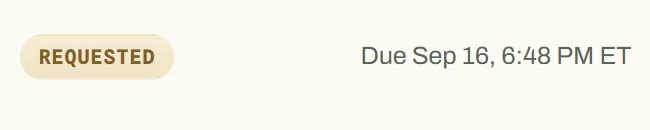
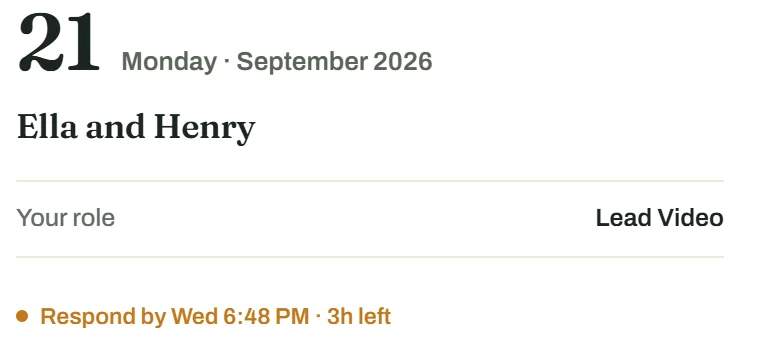
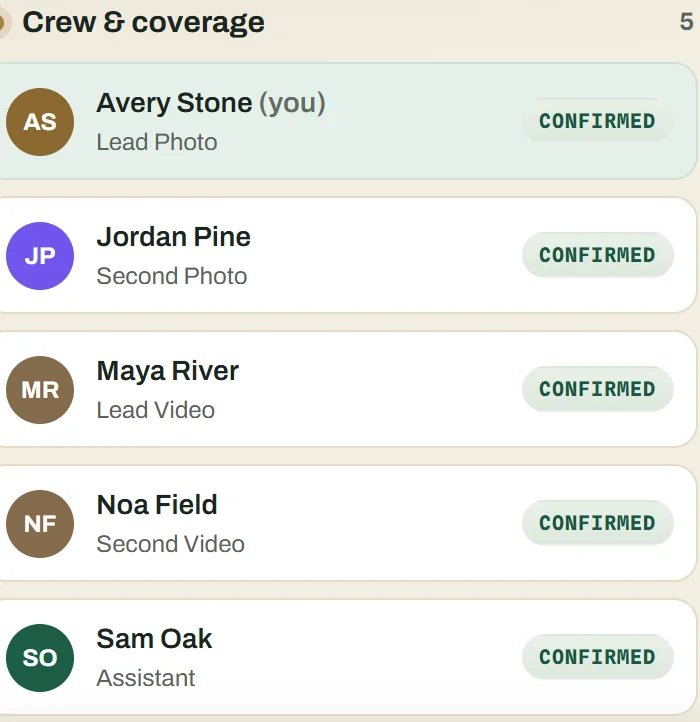
The wedding shows who is confirmed. When they accept, the role shows as confirmed, the wedding's activity records when they said yes, and the wedding shows how many of its seats are filled. If a request runs past its deadline with no answer, it shows as expired, and the role is back on your list.
The replacement gets the wedding information. Once confirmed, they see their role, their start time, their part of the schedule and the venue details on their phone, and the person who left no longer sees the wedding. Crew updates you published earlier went to the crew confirmed at that time, so if one of them matters, publish a fresh update and the new person will be asked to acknowledge it.
What it won't do: it isn't a marketplace, and it can't promise that anyone will be free on Saturday. It runs the crew you already have. It isn't a contract tool, and it doesn't move money. See how it works, or read more about what to do when a second shooter isn't answering and how to hire and confirm a second shooter in the first place.